
We work in computational materials chemistry. Our goal is to understand materials and catalysts at the level of individual atoms, and to use that understanding to design better ones. Our methods range from highly accurate correlated quantum chemistry (CCSD(T), local increments, embedding schemes) through density functional theory to machine-learned potentials and machine-learning-driven global optimization. Almost all of our projects are joint work with experimental groups, because we want our simulations to answer the open questions that experiments raise. Numbers in brackets refer to our publication list.
Atomic structures from experiment and quantum chemistry
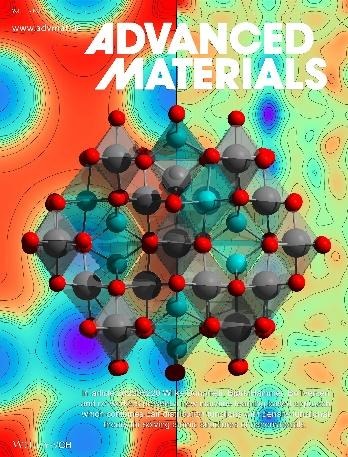
Many of the most important functional materials, such as nanoparticles, disordered solids, metastable phases and reconstructed surfaces, cannot be solved with conventional crystallography. Their scattering data are incomplete and noisy, and several atomic models often fit equally well. We developed a machine-learning-accelerated global optimization method that searches for structures which both reproduce measured X-ray or neutron pair distribution functions (PDF) and are energetically plausible according to DFT. No starting model is needed. The method solved the structure of anatase nanoparticles from PDF data alone, identified competing stacking sequences in SnS2, and revealed the Zn/Al site inversion in gahnite that a pure energy search would miss [17, 21]. Together with the DESY NanoLab, we have extended the approach to surface reconstructions determined from surface X-ray diffraction.
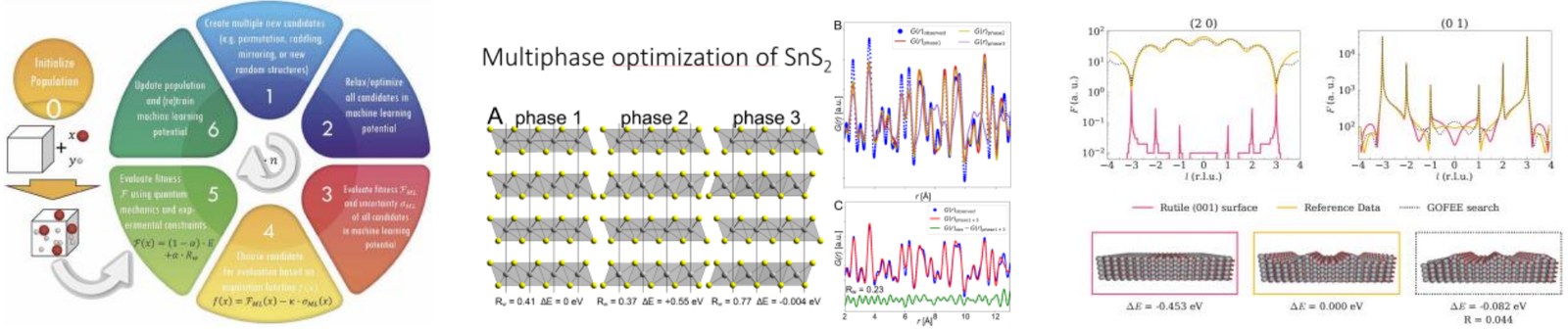
Our current work aims to treat each experimental technique (X-ray and neutron PDF, powder XRD, surface diffraction) as separate evidence with its own uncertainty. The result should not only be a structure, but also a statement of which structural features the data actually determine.
Catalysis and reactions at metal and oxide surfaces
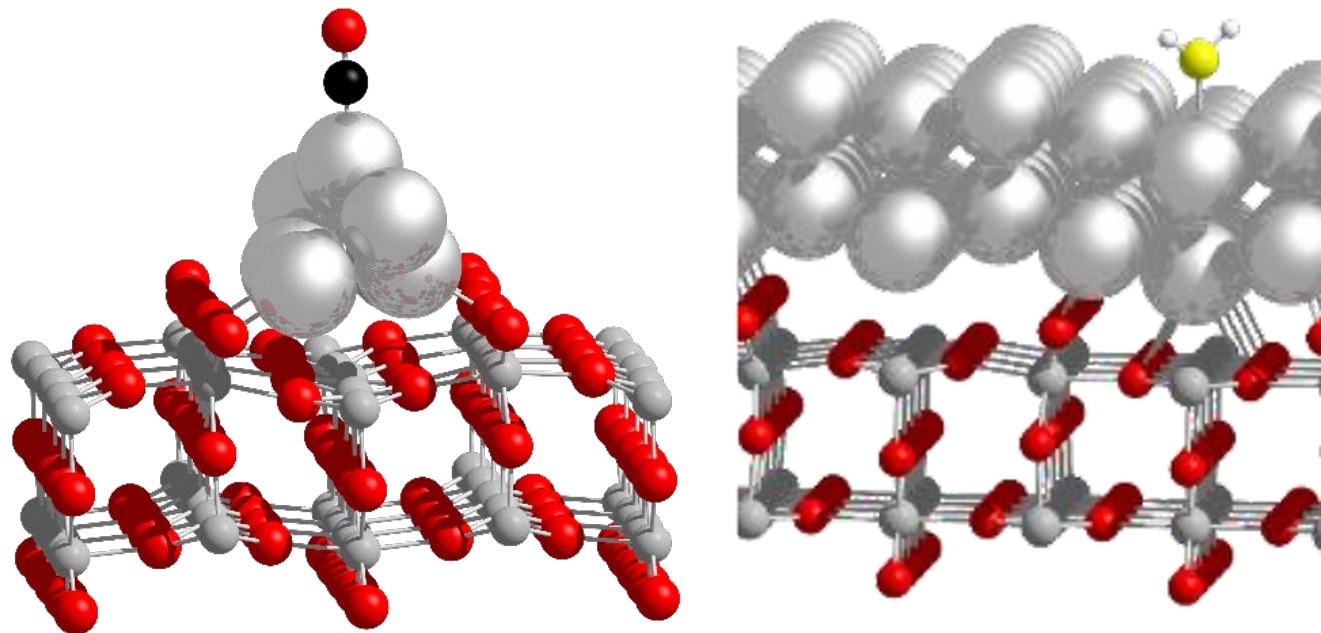
Metals. Catalysis on coinage metals has been a central theme of our work since its beginnings. We studied CO and methanol oxidation on unsupported gold, silver and copper catalysts, with a focus on nanoporous gold. A key question is how molecular oxygen is activated on gold, a metal that is famously inert in bulk. We showed how residual silver atoms, low-coordinated step and kink sites, and particle size control this activation step [7, 10, 11, 13]. Combined with infrared and Auger electron spectroscopy, we followed how CO binds to stepped gold surfaces and how oxygen reshapes the surface of nanoporous gold [6, 12]. To reach chemical accuracy for these systems, we combined DFT with CCSD(T) in an embedding scheme [7]. This work is summarized in a comprehensive review on nanoporous gold in Chemical Reviews [18].

Oxides. Oxide surfaces are both catalysts and supports for catalytic metal particles. Using the method of local increments, we analyzed CO adsorption on rutile TiO2(110) at a correlated wavefunction level [14]. Together with surface-science experiments in Aarhus, we explained how hydroxyl pairs form on reduced anatase TiO2(101) [19]. With partners in Bremen, we used multiscale modelling to study how the herbicide glyphosate and other wastewater pollutants adsorb on and degrade at crystalline and amorphous TiO2, in the dark and under illumination [26, 29]. We also study oxide-supported metal particles, for example Pt and Ru nanocrystallites on functionalized SiO2 aerogels for on-chip hydrogen combustion [27], and sub-nanometer Pt clusters on TiO2.
Active learning and machine learning potentials
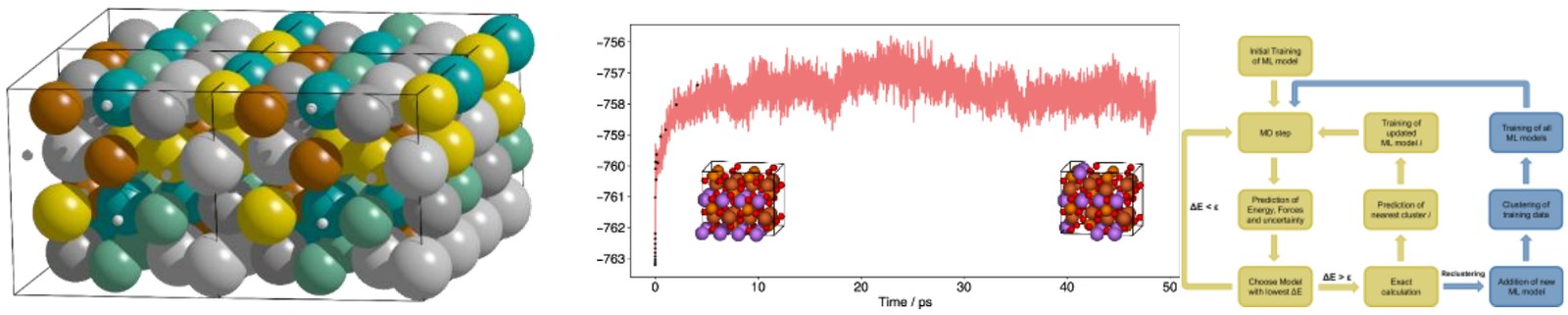
Many processes in materials, such as ion diffusion, hydrogen transport or surface restructuring, happen on time scales that are out of reach for direct ab initio molecular dynamics. Our active-learning framework FALCON trains a machine learning potential on the fly while the simulation runs. The model uses its own uncertainty to decide when a new quantum chemical calculation is needed, so expensive calculations are only done where they matter. In one example, a 25 ps simulation of a 115-atom system needed only 151 DFT calculations, which saved more than two orders of magnitude in computing time [28, 31]. FALCON is open source and works with any ASE calculator.
Energy materials
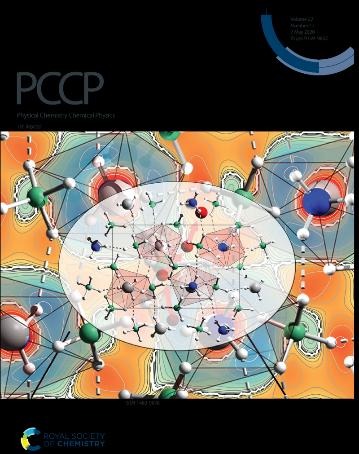
Energy storage and conversion depend on how ions and small molecules move through solids and react at their surfaces. Together with synthesis groups in Aarhus, we uncovered the mechanism of Mg2+ conduction in ammine magnesium borohydride, a solid electrolyte in which a neutral molecule promotes ion transport [15]. With FALCON we now study lithium diffusion in LiFePO4, and with global optimization we screen alloys, including high-entropy alloys, for hydrogen storage. Related work addresses hydrogen production from H2S on supported platinum catalysts.
Designing new functional materials
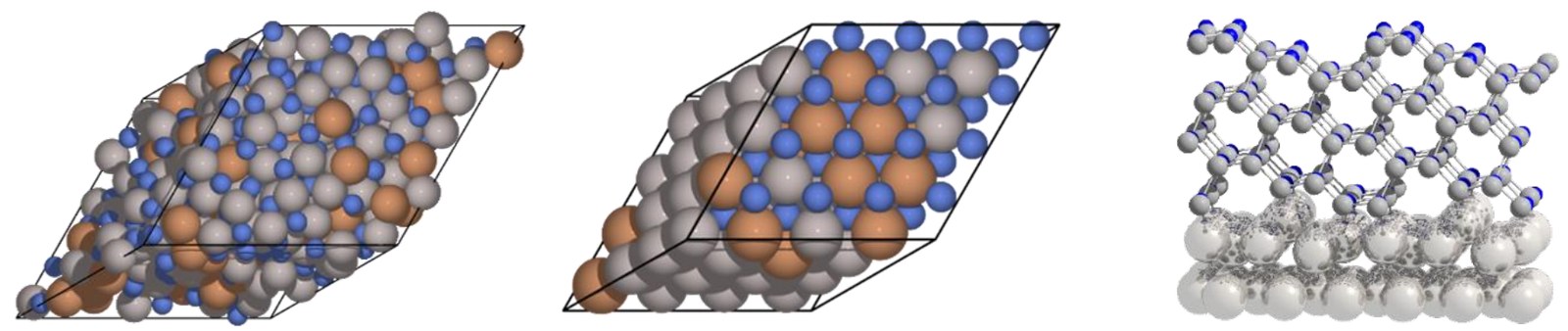
Global optimization can target a property instead of an energy or a measurement. We use this to tune the HOMO–LUMO gap of dye molecules for dye-sensitized solar cells, together with synthesis partners [20]. In metallurgy, we study how iron impurities from recycling cluster in aluminium and make it brittle, and whether targeted nitriding can counteract this. In collaboration with crystallographers, we also characterize waste-derived silica as a starting material for zeolite-type layers and membranes [32].
Materials beyond Earth
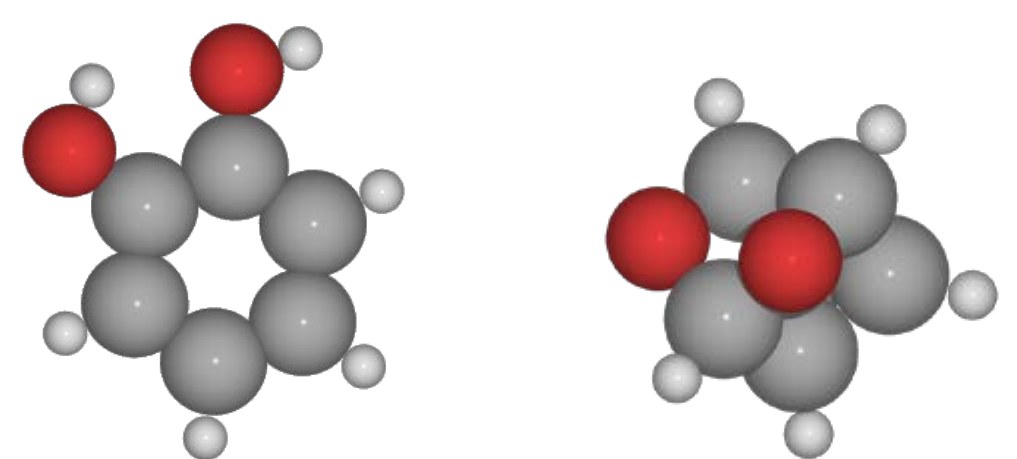
The same atomistic tools help us understand materials in space. We studied defect-rich forsterite as a representative phase of Martian regolith [25], and how point defects and polycyclic aromatic hydrocarbons help silicate dust grains survive in the interstellar medium [24]. More on our space exploration projects.
Method development
Beyond applications, we develop methods: correlated wavefunction approaches and QM|QM embedding for surfaces and nanoparticles [7, 14], anharmonic vibrational spectra from second-order vibrational perturbation theory accelerated by machine learning, and strain analysis of molecular and periodic systems under deformation [23]. We also contributed to a review of computational high-pressure chemistry [22]. Our codes are open source; see Code & Software.
Outlook: quantum computing
As an exploratory side project, we test how variational quantum algorithms can be integrated into atomistic simulation workflows, on simulators and current quantum hardware, always compared against classical reference calculations [30].
Collaborations
We are grateful to work with T. M. Gesing, E. Schmidt, T. Neudecker, L. Colombi Ciacchi and S. Köppen (University of Bremen), V. Vonk and A. Stierle (DESY NanoLab, Hamburg), B. B. Iversen, B. Hammer, S. Wendt and J. V. Lauritsen (Aarhus University), L. Borchardt (Ruhr University Bochum), A. G. G. M. Tielens (Leiden University), L. V. Moskaleva (University of the Free State) and N. Marzari (EPFL).