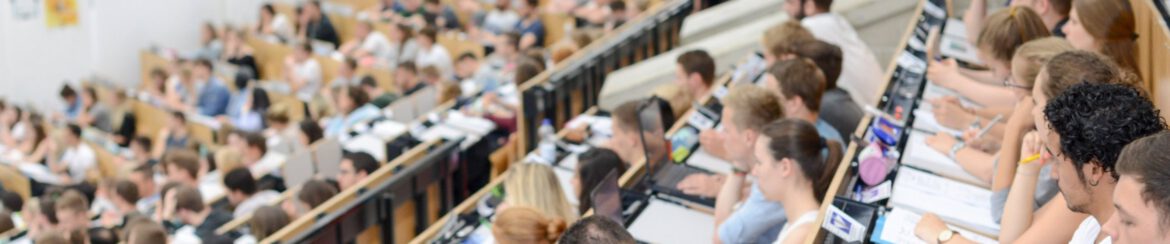
We teach computational chemistry and data analysis in the master’s programmes of the University of Bremen. Our courses combine short theory blocks with hands-on sessions at the computer, so that students can apply what they learn right away. Both regular lectures take place in the summer semester, most recently in SoSe 2026.
Bachelor’s and master’s thesis topics and research modules are available at any time. Students from Chemistry, Geosciences (M.Sc. Materials Chemistry and Mineralogy) and Production Engineering at the University of Bremen are welcome to apply. Just send Wilke an email.
You can also find some mini lectures and educational presentations on different topics from the past years.
Computational Materials Science (05-MCM-CM)
M.Sc. Materials Chemistry and Mineralogy (elective, 6 CP) · summer semester · taught in English, together with Prof. Dr. Tim Neudecker. Students from M.Sc. Chemistry and M.Sc. ProMat may join after contacting me.
Learning contents
The most important computational methods for the quantum mechanical modelling of materials in the electronic ground state are discussed in detail. After the lecture block, the methods are applied in a practical course towards the end of the semester. The module covers Hartree–Fock theory, electron correlation and post-Hartree–Fock methods, density functional theory, basis sets (Gaussian and plane-wave), and calculations with periodic boundary conditions.
Learning outcomes
Students gain an understanding of state-of-the-art computational methods in materials chemistry and mineralogy. They will be able to:
- assess the reliability of a given computational method for describing an experiment, for example when reading the literature
- devise basic computational protocols to calculate a desired property
- use quantum mechanical program packages in practice
Module details
| Prior knowledge | Basic knowledge of quantum mechanics and molecular orbital theory |
| Course types | Lecture: 3 SWS (42 h) Practical: 1 SWS (14 h) |
| Workload | 56 h presence time 84 h self-study 40 h exam preparation 180 h in total |
| Examination | Combination exam with 2 elements: 70 % oral exam, 30 % practical report |
| Literature | Cramer: Essentials of Computational Chemistry Szabo/Ostlund: Modern Quantum Chemistry Parr/Yang: Density-Functional Theory of Atoms and Molecules Martin: Electronic Structure: Basic Theory and Practical Methods |
Data Processing and Plotting in Chemistry (WDAT)
M.Sc. Chemistry (elective, 6 CP) · summer semester · module coordinator: Dr. Wilke Dononelli
Learning contents
The course combines short lectures on the basics of Python programming with hands-on programming sessions:
- Overview of programming languages and plotting tools
- Structural and scientific databases
- Basics of Python: variables, lists and arrays, basic maths, reading and writing files, functions and classes
- Processing of larger data sets from organic, inorganic and physical chemistry
- Visualisation with Matplotlib
- Graphical presentation and interpretation of experimental data, e.g. IR or NMR spectra, XRD data and quantum chemical calculations
- A first look at machine learning methods for fitting and predicting data
- Using large language models as a help when programming
Learning outcomes
Students learn how to process typical scientific data from chemical experiments and simulations. They apply basic mathematical operations to their data and analyse and plot it at the level required for scientific publications. Along the way, they learn the basics of Python, a skill that is useful far beyond plotting experimental results.
Module details
| Prior knowledge | Basic knowledge of chemical experiments. No programming experience needed. |
| Course types | Lecture: 2 SWS (28 h) Practical: 2 SWS (28 h) |
| Workload | 56 h presence time 84 h self-study 40 h exam preparation 180 h in total |
| Examination | Combination exam with 2 elements: 50 % oral exam, 50 % practical report |
Research Modules Chemistry I and II (05-MCM-CR1 / CR2)
M.Sc. Materials Chemistry and Mineralogy · six-week full-time project · any time by arrangement
What you do in our group
In a research module, you work on your own small research project in atomistic simulation, usually as part of an ongoing project in our group. Depending on your interests, this could mean:
- solving the structure of a material by combining diffraction data with DFT and machine-learning-driven global optimization
- calculating reaction mechanisms on catalytic metal or oxide surfaces
- training machine learning potentials and running molecular dynamics simulations with FALCON
- computing properties or spectra of materials together with an experimental group in Bremen
Along the way, you learn to work with Linux and high-performance computers, to write Python scripts with ASE, and to use quantum chemistry codes. At the end, you summarise your results in a report written in the style of a scientific paper. A research module is also a good way to find out whether you want to do your master’s thesis in computational chemistry.
Learning outcomes
- Planning and organising a self-designed research project
- Carrying out, analysing and evaluating simulations and scientific data
- Writing scientific reports and taking first steps towards a scientific publication
Module details
| Prior knowledge | Fundamental knowledge of materials chemistry. Prior experience with simulations is not required. |
| Course type | Practical: 10 SWS (140 h) |
| Workload | 140 h presence time 140 h self-study 80 h exam preparation 360 h in total |
| Examination | 1 exam element (100 % project report) and 1 ungraded course achievement (SL) |